International Conference |South of Asia: Aesthetics, Theory, Archive
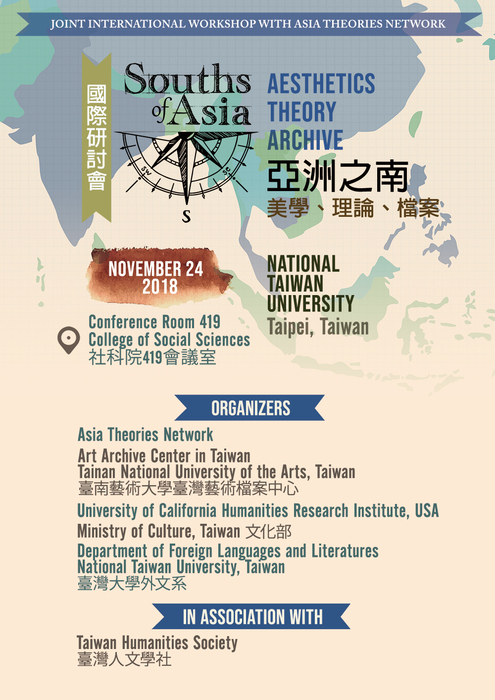
Date: November 24 (Sat.), 2018
Place: Conference Room 419, College of Social Sciences, National Taiwan University, Taipei, Taiwan
Program
Session: 10:00-11:00
Theme: Expansion and Distribution
Moderator: Shu-Mei Shih (史書美) (Univ. of California at Los Angeles,
USA)
- Gridthiya Gaweewong (Jim Thompson Art Center, Thailand)
Title: Expanding the global south network: through the lens of
curatorial practices
- Chun-Mei Chuang (張君玫) (Soochow Univ., Taiwan)
Title: Distributed Cognition in Art and Theory
Session: 11:00-12:00
Theme: Time and Locality of the South
Moderator: David Theo Goldberg (Univ. of California Humanities
Research Institute, USA)
- Yogita Goyal (Univ. of California at Los Angeles, USA)
Title: It is the Moment to Strike at Time
- SENG Yu Jin (辛友仁) (National Gallery Singapore, Singapore)
Title: Rethinking Nanyang Art as a Forceful Weapon
Lunch: 12:00-13:30
Session: 13:30-14:30
Theme: Archive and Representation
Moderator: Li-Chun Hsiao (蕭立君) (National Taiwan Univ., Taiwan)
- Po-Shin Chiang (蔣伯欣) (Tainan National Univ. of the Arts, Taiwan)
Title: When the Replicas Become Form: On the Representation of
Art Archives in light of the Notions of Harald Szeemann’s
“Museum of Obsessions” and Lina Bo Bardi’s “Poor
Architecture”
- Alex Taek-Gwang Lee (Kyung Hee Univ., South Korea)
Title: The “Mnemosyne Atlas” of the South: Apichatpong and
Archives against Representation
Session: 14:30-15:30
Theme: Counting and Collecting
Moderator: Woosung Kang (Seoul National Univ., South Korea)
- Oscar V. Campomanes (Ateneo de Manila Univ., Philippines)
Title: How Elmer Borlongan Counts and How He Makes His Social
Others Count in his Art
- Jau Lan Guo (郭昭蘭) (Taipei National Univ. of the Arts, Taiwan)
Title: Who Is Collecting?
Coffee Break: 15:30-16:00
Session: 16:00-17:00
Theme: War and Coloniality
Moderator: Christophe Thouny (Kyushu Univ., Japan)
- Kenji Kajiya (加治屋 健司) (Univ. of Tokyo, Japan)
Title: Japanese Painters on the Southern Front
- Chien-hung Huang (黃建宏) (Taipei National Univ. of the Arts, Taiwan)
Title: [“Paracolonial@Technology”]
Organizers
-
Asia Theories Network
-
Art Archive Center in Taiwan, Tainan National
University of the Arts, Taiwan (臺南藝術大學臺灣藝術檔案中心)
-
University of California Humanities Research Institute, USA
-
Ministry of Culture, Taiwan (文化部)
-
Department of Foreign Languages and Literatures, National Taiwan University,
Taiwan (臺灣大學外文系)
In association with
- Taiwan Humanities Society (臺灣人文學社)
Contact: Assistant Yu Jin (金妤 助理): yujinn1318@gmail.com
Theme
This “Souths of Asia: Aesthetics, Theory, Archive” international workshop is a joint initiative of the Asia Theories Network; the Art Archive Center in Taiwan, Tainan National University of the Arts, Taiwan; the University of California Humanities Research Institute, USA; and Taiwan government’s Ministry of Culture. The event is also associated with the Taiwan Humanities Society and is hosted by the Department of Foreign Languages and Literatures, National Taiwan University, Taiwan. In this workshop, we will gather scholars and important figures from contemporary Asian art and critical theory to have a discussion and dialogue on “the aesthetics of the south” and extensively on the implications for the archive. The “south” has become a significant subject for the critical humanities in recent times. We see its ethico-politcial potentialities in critical discussions that are committed to alternative paradigms that contest, resist, or flee from the dominant modes of both the imperial North and West and the post-imperial globalized world.
The “south” broadly signifies the possibility or actuality of socio-cultural and artistic practices that are off the center, non-hierarchical and more horizontal, co-existent rather than dominant, singular rather than monolithic, egalitarian in ontology and socio-political fields, resistant to domination and violence, etc. Along with the decline of Western imperialism and the rise of globalization, these alternative paradigms are being sought considerably in “the Global South,” which mostly refers to the previous colonial and third-world areas largely located in the geographical souths of the world, including the south of Asia which means a site of both practice and concern for this workshop. Here we see the ambiguous relationships between the critical theoretical and the geographical, but the two need not be exclusive or incompatible because their relationships are not logical. Rather, they can be real and necessary, if truly effective practices are to take place in the sense of existing both in and beyond any real place.
By this workshop, we intend to enrich and open up our imaginations of the south, so much so that it is not limited to any fixed place, but is implicated in the global forces that determine its existence. On the other hand, we are concerned with these alternative practices as they are produced in particular sites of the Asian south. We would rather not exclude but accommodate all these “souths,” as they are envisioned critically and theoretically but also geographically, locally, and pragmatically.
What is in common between modern art and modern humanistic discourse is their departing from the representative or dominant and moving toward the plebian, minoritarian, and subjugated. This egalitarian and critical character can be the basis for the two fields’ concern with the south. The speakers can focus on any aspects of the “southern” aesthetics as it means to him/her as exemplifying resistances, critical responses to domination, and alternative possibilities of all kinds. On the other hand, both discourse and art are ways of practice of archiving, at least in the sense of preserving thoughts and sensations. The “southern” concern should alter or problematize our common understandings of the archive, pointing toward the archival implications which theory and art can bring forth; for example, what might be the possible modes of “southern archives” or “southern archiving”? In general, the speakers of the workshop will deliberate on the relationships between aesthetics, theory, and archive as the three subjects bear on the “south.” By enlarging our imaginations and discourses of the south, we hope to open up a fertile platform for and to experiment with trans-disciplinary or -field dialogues and collaborations, here between art and critical theory. We also aim for this relatively expanded or diversified mode of dialogue and discussion to give birth to more concrete subjects for future initiatives and engagements.